
Submission Background
Brennan Furlong submission related to Theme 7 of the Dublin City Development Plan 2022-2028: Green Infrastructure, Open Space, Recreation and Natural Heritage
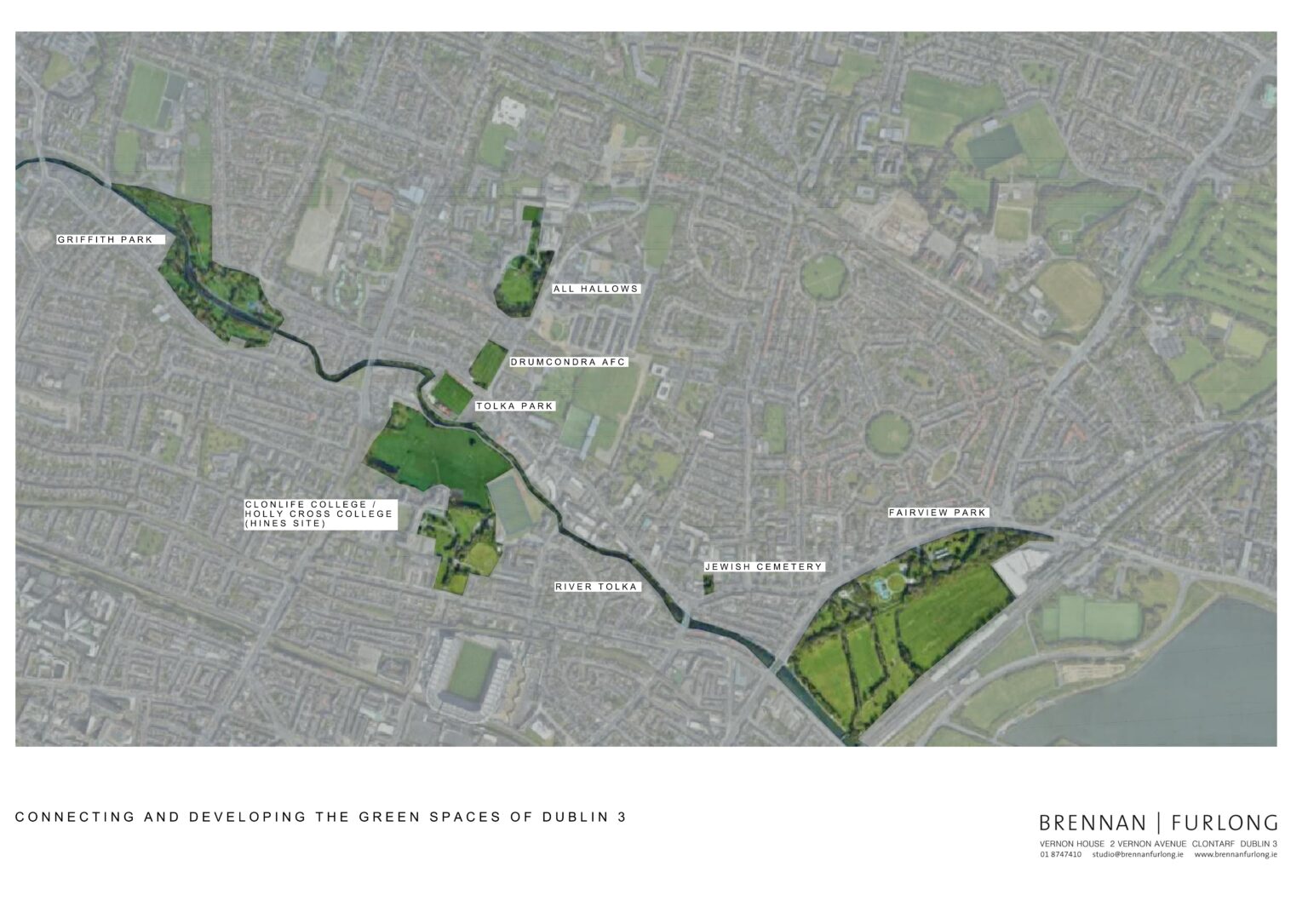
Between Griffith Park in the north-west, and Fairview Park in the south-east, the Dublin 3 and Dublin 9 areas contain large green spaces, both public (in the form of parks) and private (in the form of primarily institutional lands). The two post-codes are currently undergoing significant & welcome development which will see the provision of thousands of new homes in the area over the coming years, bringing many thousands more residents who will make the areas of Drumcondra, Fairview, Ballybough, Marino, Clontarf, North Strand and East Wall their home.
The link between Griffith and Fairview Parks is the Tolka river. The river is little more than a stream until it reaches Finglas, and from there, as it winds its way across the north city suburbs, it forms a route along which a number of parks and green spaces are arranged. From Tolka Valley Park in Finglas, on to Violet Hill Park, it then skirts Glasnevin Cemetery and winds through the Botanic Gardens. It then bisects Griffith Park before almost disappearing from view and public consciousness and re-emerging along the south-western edge of Fairview Park. From there it passes below 4 bridges before opening into the bay flanked by the East Point Business Park and the Clontarf Promenade.
Between Griffith Park and Fairview Park, the river passes by or adjacent to a number of green spaces. It winds around Tolka Park football stadium, which is due to be re-developed for social housing in the coming years, and lies adjacent to the lower end of Grace Park Road which itself is lined with green spaces (primarily the grounds of former or current institutional lands, such as St. Josephs and All Hallows). On the other bank of the river, it passes the grounds ofHoly Cross College, which is the site of a significant development by Hines and includes plans for a river-side walk.
Beyond here, the river almost disappears from public view. A truncated board-walk runs for a portion of the northern bank along Richmond Road but stops before it can connect with the Luke Kelly Bridge or the sliver of green space opposite Richmond Avenue. Between the Luke Kelly Bridge and the Annesley Bridge the river is addressed to an extent by the shared space of the Poplar Row flats complex, but ignored by the properties which front onto Cadogan Road on the opposite bank.
The relationship between the Tolka and Fairview Park is much less successful, and much less exploited than the relationship between the river and parks further upstream. Yet for 300m the park enjoys a south-west facing aspect onto the river which is waiting to be developed. Directly opposite, the former CEMEX site and the Fire Station (which is mooted to be relocated also) present a development site which may provide much needed additional housing in the near future.
The area as a whole abounds with Green Spaces, yet these spaces are poorly connected, particularly in the vicinity of Richmond Road, itself the subject of an Area Action Plan in 2007. Examining and developing the amenity of the river offers an opportunity to connect – either directly or simply in the minds of residents – these spaces as a ribbon of individual elements within an overall green space network that could provide a wonderful amenity to serve local residents – both those living there now, and those the new developments will bring. The precedent of the tow-paths along the Royal Canal used by joggers and walkers alike, and the oft-maligned, albeit well-used boardwalk along the northern bank of the Liffey offer templates of what can be achieved. The welcome impending development of the tea-rooms in Fairview Park will draw further visitors to the park, and an improved, seated amenity connecting the southern boundary of the park and the northern bank of the river would add significantly to the amenity value serving the area as a whole.